Why Interest Type Matters
In the world of personal finance, few concepts are as fundamental yet as misunderstood as interest. Whether you are looking to take out a loan, save for retirement, or manage a business, the type of interest being applied to your capital will dictate your financial health for years to come. In 2026, as digital banking and instant credit become part of our daily lives, distinguishing between Simple Interest and Compound Interest is more critical than ever.
Most people realize interest is simply the "cost of borrowing" or the "reward for saving," but the mathematical mechanism behind that cost can lead to vastly different outcomes. One can be your best friend (helping your wealth grow exponentially), while the other can become a growing burden if you're on the borrowing side. Understanding these mechanics helps you choose the right financial products and avoid hidden costs that can derail your financial goals.
What is Simple Interest?
Simple Interest is the most straightforward way to calculate interest. It is calculated only on the principal amount, or the initial amount of money that was deposited or borrowed. The interest amount remains constant throughout the entire duration of the loan or investment, as long as the interest rate and the principal don't change.
The formula for Simple Interest is: SI = P × R × T, where P is the Principal, R is the Annual Interest Rate, and T is the Time in years.
Because of its predictability, Simple Interest is commonly used in several real-life scenarios:
- Short-term Loans: Many personal loans or informal lending between friends use simple interest because it's easy to calculate.
- Certain Fixed Deposits (FDs): Some traditional savings schemes pay out interest monthly or quarterly based on the original principal.
- Academic Math: This is usually the first financial concept taught in schools because it provides a clear, linear understanding of how money earns value over time.
- Auto Loans: Many car loans use a simple interest calculation method where interest is computed on the daily balance.
What is Compound Interest?
Compound Interest is often described by financial experts as the "eighth wonder of the world." Unlike simple interest, compound interest is calculated on the initial principal AND also on the accumulated interest of previous periods. Effectively, it is "interest on interest."
The power of compounding comes from the fact that your money grows at an accelerating rate. Each time interest is added back to the principal, the next interest calculation happens on a larger sum. This creates a "snowball effect" that is incredibly powerful over long periods.
The frequency of compounding—whether daily, monthly, quarterly, or annually—matters significantly. The more frequently interest is compounded, the higher the final amount will be. In 2026, most modern savings accounts, credit cards, and investment portfolios (like mutual funds and stocks) operate on the principle of compounding. It is the primary engine behind long-term wealth creation and the reason why starting to invest early is the single most important advice given to young professionals.
Side-by-Side Comparison
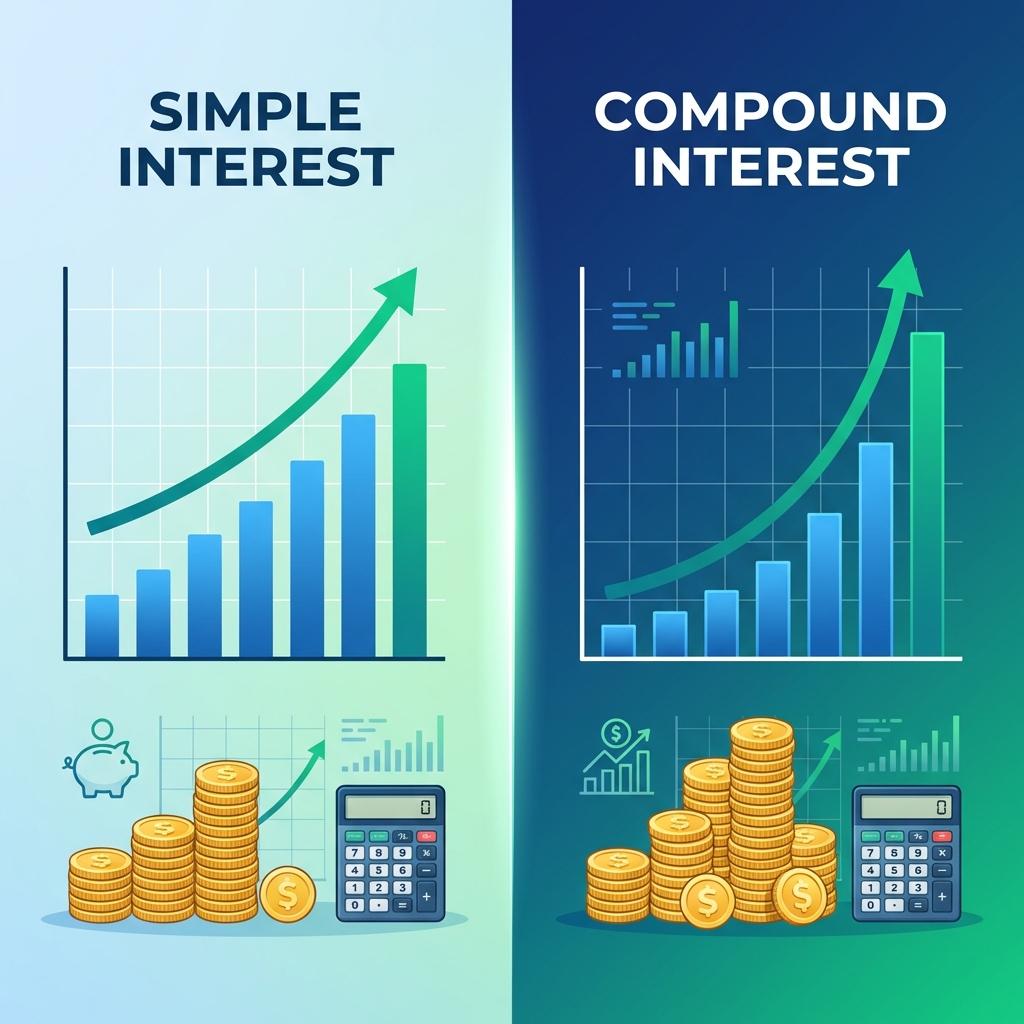
To help you visualize the difference quickly, here is a comparison of how these two types of interest behave under similar conditions:
| Feature | Simple Interest | Compound Interest |
|---|---|---|
| Calculation Base | Only the Principal | Principal + Accumulated Interest |
| Growth Pattern | Linear (Constant) | Exponential (Accelerating) |
| Interest Amount | Same every year | Increases every year |
| Main Benefit | Easier to calculate/manage | Maximizes long-term returns |
Real-World Examples: Same Money, Different Results
Let's put these formulas into action. Imagine you have ₹1,00,000 to invest for 10 years at an annual interest rate of 10%.
Simple Interest Scenario
Each year, you earn 10% of ₹1,00,000 = ₹10,000.
- Year 1: ₹1,10,000
- Year 5: ₹1,50,000
- Year 10: ₹2,00,000
Total Interest: ₹1,00,000
Compound Interest Scenario
Interest is added to the total each year (Annual Compounding).
- Year 1: ₹1,10,000
- Year 5: ₹1,61,051
- Year 10: ₹2,59,374
Total Interest: ₹1,59,374
As you can see, after 10 years, the compound interest account earned ₹59,374 more than the simple interest account. If you extended this to 20 or 30 years, the gap would grow from a small difference to a life-changing amount of money. This is why compound interest is the engine of retirement savings and long-term wealth.
When to Use Which?
Understanding which interest type is "better" depends entirely on which side of the transaction you are on.
If you are INVESTING: Compound interest is your best friend. You want your money to compound as frequently as possible (daily or monthly being better than annually). This applies to your savings accounts, your retirement funds, and your long-term stock market investments. The goal here is to let time and compounding do the heavy lifting for you.
If you are BORROWING: Simple interest is generally preferable. You want the cost of your debt to be linear and predictable, rather than compounding. While most large loans (like mortgages) use compounding, some smaller auto loans or personal loans use simple interest. It's always worth asking your lender how interest is calculated.
The Danger Zone: Credit Cards. Credit cards are the most common way people fall victim to compound interest. They compound daily or monthly at very high rates. If you only pay the minimum balance, the "interest on interest" can cause your debt to grow faster than you can pay it off.
Helpful Tools & FAQs
Making these calculations manually can be tedious. That's why we've built specific tools to help you visualize your financial future:
- Check out our EMI Calculator to see how interest impacts your monthly loan repayments.
- Calculate growth with our Compound Interest Calculator.
- For linear loans, use the Simple Interest Calculator.
- Use our Percentage Calculator for quick interest rate comparisons.
Frequently Asked Questions
1. Is fixed deposit interest simple or compound?
It can be both. Traditional FDs that pay out interest periodically are simple interest. FDs where the interest is reinvested (cumulative FDs) use compound interest.
2. How can I maximize my compound interest?
Two ways: Start early (time is the most important factor) and look for higher compounding frequency (monthly compounding earns more than annual compounding).
3. Why do banks use compound interest for loans?
Compounding allows banks to earn more from the money they lend over long periods. It reflects the "opportunity cost" of the money they have given to you.
Final Verdict
There is no single "better" interest type—it all depends on whether you're earning it or paying it. Understanding the math behind your money allows you to choose investments that grow faster and loans that cost less. In the financial landscape of 2026, being "interest-literate" is your strongest asset.
Share this article
Send it to your team, save it for later, or continue the workflow in a calculator.