🎯 Quick Summary
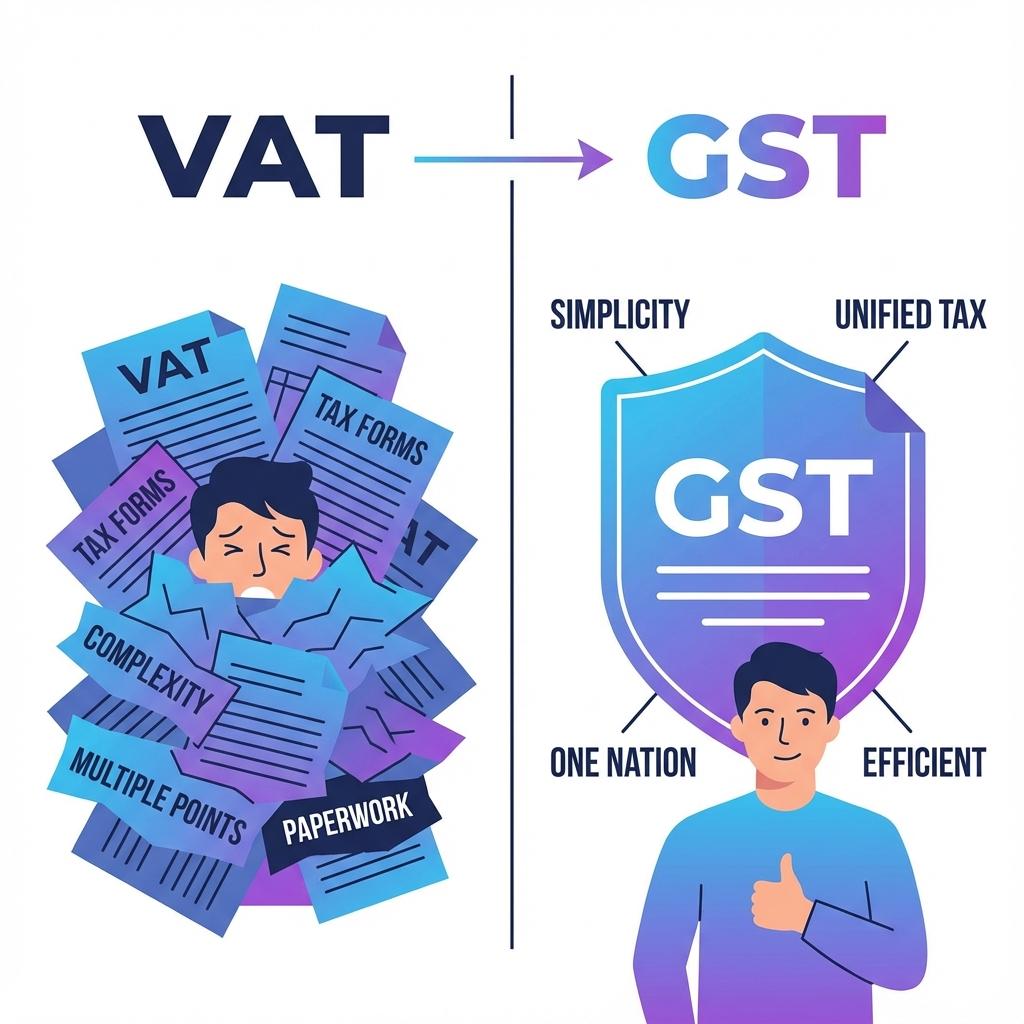
GST (Goods and Services Tax) replaced VAT (Value Added Tax)in India on July 1, 2017. GST is a unified tax system that replaced multiple indirect taxes including VAT, service tax, excise duty, and others.
What Was VAT?
VAT (Value Added Tax) was a state-level tax levied on goods. It had several limitations:
- Applied only to goods, not services
- Different rates in different states (creating confusion)
- Cascading tax effect (tax on tax)
- Multiple taxes applied at different stages
- No uniform tax system across India
What is GST?
GST is a comprehensive, destination-based tax levied on the supply of goods and services. Key features:
- Applies to both goods and services
- Uniform tax rates across India
- Eliminates cascading tax effect
- Input Tax Credit (ITC) system
- Single tax system replacing multiple taxes
Key Differences: GST vs VAT
| Aspect | VAT | GST |
|---|---|---|
| Scope | Only goods | Goods + Services |
| Tax Structure | State-level only | CGST + SGST (intrastate) or IGST (interstate) |
| Tax Rates | Varied by state | Uniform across India (5%, 12%, 18%, 28%) |
| Input Credit | Limited | Seamless across goods and services |
| Cascading Effect | Present (tax on tax) | Eliminated |
| Compliance | Multiple registrations | Single registration, unified returns |
Benefits of GST Over VAT
✅ Unified System
One tax system replaces multiple taxes (VAT, service tax, excise, etc.), simplifying compliance.
💰 Better Input Credit
Seamless credit across goods and services reduces overall tax burden.
🌐 Interstate Trade
IGST system makes interstate transactions simpler and more efficient.
📊 Transparency
Digital invoicing and online returns increase transparency and reduce fraud.
Impact on Businesses
Positive Impacts:
- Reduced compliance burden (single registration instead of multiple)
- Better cash flow due to seamless input tax credit
- Easier interstate trade and expansion
- Lower overall tax burden for most businesses
Challenges:
- Initial adaptation to new system
- Technology requirement for digital compliance
- Training staff on GST procedures
Share this article
Send it to your team, save it for later, or continue the workflow in a calculator.