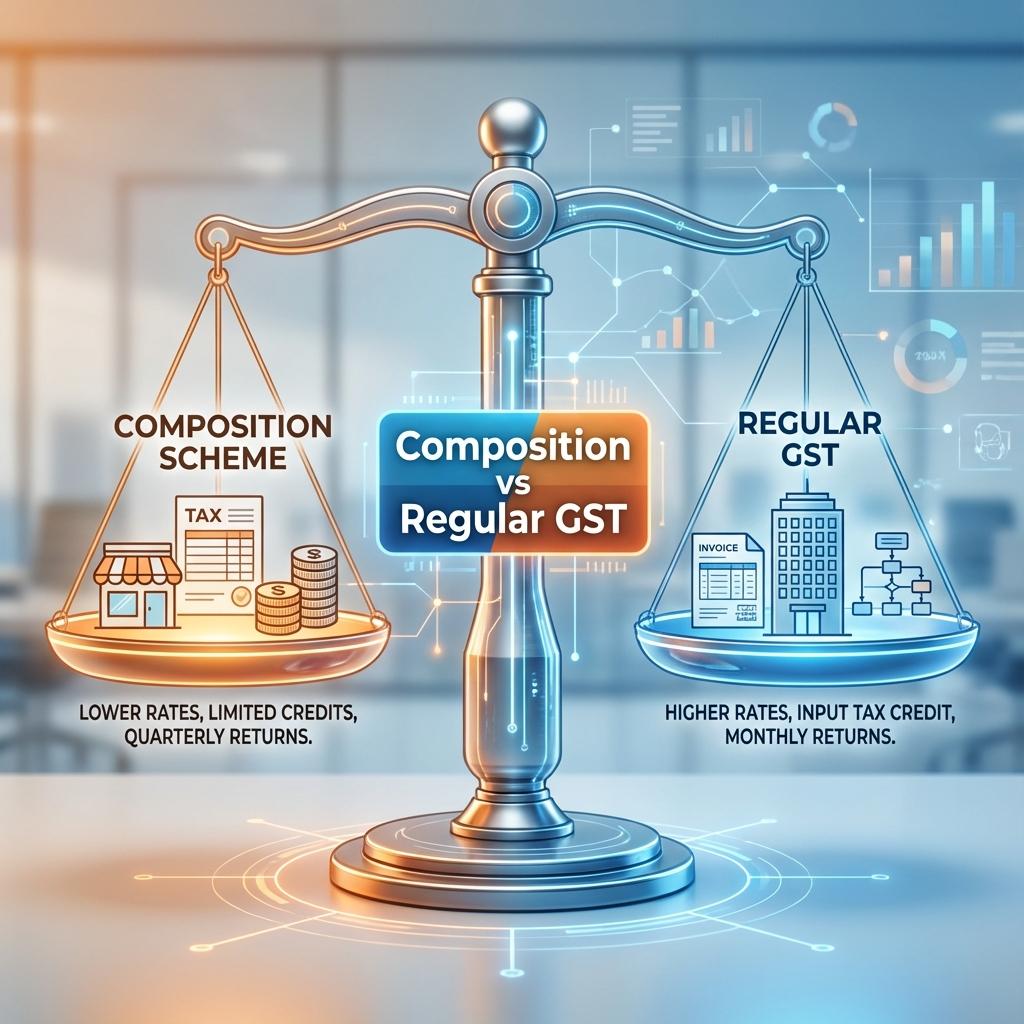
Small business owners in India often face a dilemma when registering for GST: should they opt for the Regular Scheme or the Composition Scheme? Both have distinct advantages and limitations.
What is the Composition Scheme?
The Composition Scheme is a simple and easy scheme under GST for taxpayers. Small taxpayers can get rid of tedious GST formalities and pay GST at a fixed rate of turnover. This scheme can be opted for by any taxpayer whose turnover is less than ₹1.5 Crore.
Comparison Table
| Feature | Regular Scheme | Composition Scheme |
|---|---|---|
| Tax Rate | Standard rates (5%, 12%, 18%, 28%) | Lower fixed rates (1% for traders/manufacturers, 5% for restaurants, 6% for service providers) |
| Input Tax Credit (ITC) | Available | Not Available |
| Inter-state Sales | Allowed | Not Allowed (Can only sell within state) |
| Tax Invoice | Must issue Tax Invoice | Cannot issue Tax Invoice (Bill of Supply instead) |
| Returns | Monthly (GSTR-1, GSTR-3B) | Quarterly (CMP-08) & Annual |
Pros & Cons
Regular Scheme
Pros:
- Can claim Input Tax Credit (ITC), reducing costs.
- Can sell across India (Inter-state) and export.
- Preferred by B2B clients who want to claim ITC.
Cons:
- Higher compliance burden (monthly returns).
- Complex record-keeping.
Composition Scheme
Pros:
- Lower tax liability.
- Less compliance (quarterly returns).
- Simple records.
Cons:
- Cannot collect tax from customers.
- Cannot claim ITC on purchases.
- Restricted to intra-state sales only.
Which one should you choose?
Choose Composition Scheme if:You are a small retailer or restaurant with mostly B2C customers, you don't plan to sell outside your state, and your profit margins are high enough to absorb the tax cost (since you can't collect it).
Choose Regular Scheme if: You are a B2B business, you plan to expand nationally, or you have significant input costs (rent, raw materials) on which you want to claim credit.
Share this article
Send it to your team, save it for later, or continue the workflow in a calculator.